



Ebola Outbreak in DR Congo: Death Toll Reaches 600 as Infections Cross 1,750
The Ebola outbreak in the Democratic Republic of the Congo has claimed 600 lives and infected more than 1,750 people, with suspected cases emerging in Kisangani.
 Prasanth Subramani
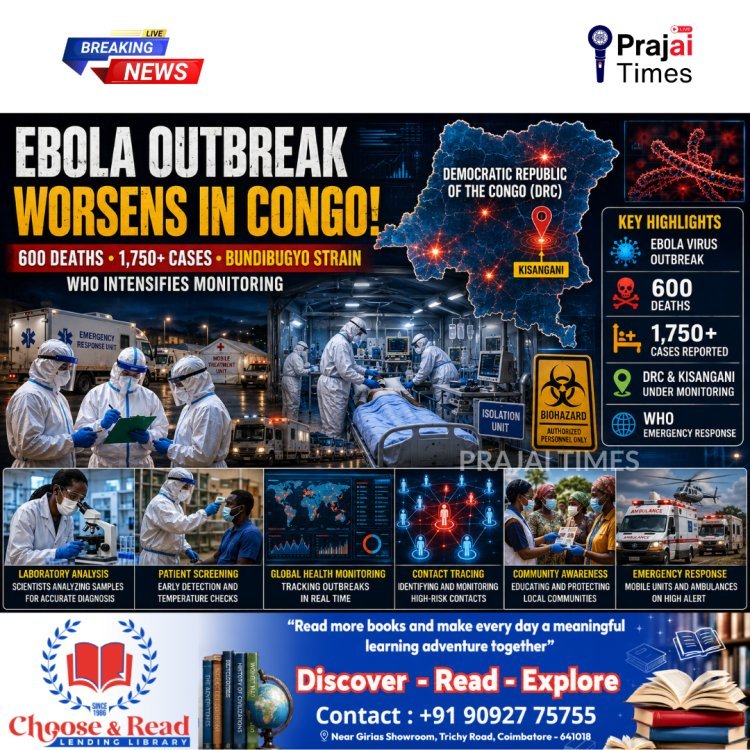

The Ebola virus outbreak in the Democratic Republic of the Congo (DRC) has reached a critical stage, with the death toll rising to 600 and more than 1,750 confirmed infections since the outbreak was declared in May 2026. Health authorities have confirmed that the outbreak is being driven by the Bundibugyo strain of the Ebola virus, which continues to spread despite ongoing containment efforts.
Global concern has intensified after suspected Ebola cases were reported in Kisangani, one of the DRC's largest and most densely populated cities. The emergence of cases in a major urban center has heightened fears of wider community transmission. In response, health officials have expanded contact tracing, laboratory testing, surveillance, and emergency response operations in an effort to contain the outbreak.
The situation has been further complicated by a strike involving frontline healthcare workers in the outbreak's epicenter. Medical staff have cited delayed salary payments, shortages of personal protective equipment (PPE), and challenging working conditions as reasons for the industrial action. Public health experts warn that disruptions to healthcare services could hamper containment efforts and increase the risk of additional infections.
The World Health Organization (WHO) continues to classify the outbreak as a serious public health emergency. Health authorities note that there is currently no approved vaccine specifically targeting the Bundibugyo strain of Ebola, although international agencies are accelerating the deployment of rapid diagnostic tests, experimental treatments, and emergency medical assistance to help control the spread of the virus.
Health officials are urging people in affected areas to avoid direct contact with infected individuals and bodily fluids, seek immediate medical attention if symptoms develop, and strictly follow public health guidance. International health organizations remain on high alert as efforts continue to prevent the outbreak from spreading further across Central Africa.